




 By Andrew West
DOVER — For some time, Delaware’s “Liberty Bell” was propped up on some wood, looking a bit sad and neglected, next to an empty garden.
With the nation’s 250th birthday approaching, this was not the best time for caution tape and a “Preservation in Progress” sign around the 76-year-old replica.
“It was awful that it was sitting on wood pallets,” said Erik Raser-Schramm, the director of Delaware 250. “Here’s a symbol of our democracy, and it was something given to each of our states.
“So, I just knew as director of Delaware 250 that we had to get that in shape — not just for the July Fourth festivities of Dover but also for Dover Days.”
Mr. Raser-Schramm connected with Dover Mayor Robin Christiansen, Kent County Levy Court President Joanne Masten, state Sen. Trey Paradee and others to figure out a plan. All this work and worry started back in January.
With some funds from the Delaware Department of State, the yoke and a support pole have been repaired.
Meanwhile, for those who regularly walk around Legislative Mall or visit occasionally, there was a noticeable absence of tulips this spring. All the flowers were gone.
Delaware 250 provided funds to the Col. John Haslet chapter of the Daughters of the American Revolution to purchase 700 plants for the site. A new design with red, white and blue flowers will give the appearance of the Betsy Ross flag.
Don’t just check out the bell the next time you’re there. Study the boxwoods, the flower beds and the sidewalk around the flagpoles, and you will see the layout is in the shape of the Liberty Bell.
***
This might just be the Liberty Bell replica’s brightest moment since 1976, when it was placed there for the nation’s 200th birthday.
Prior to that, the bell never seemed to get much respect.
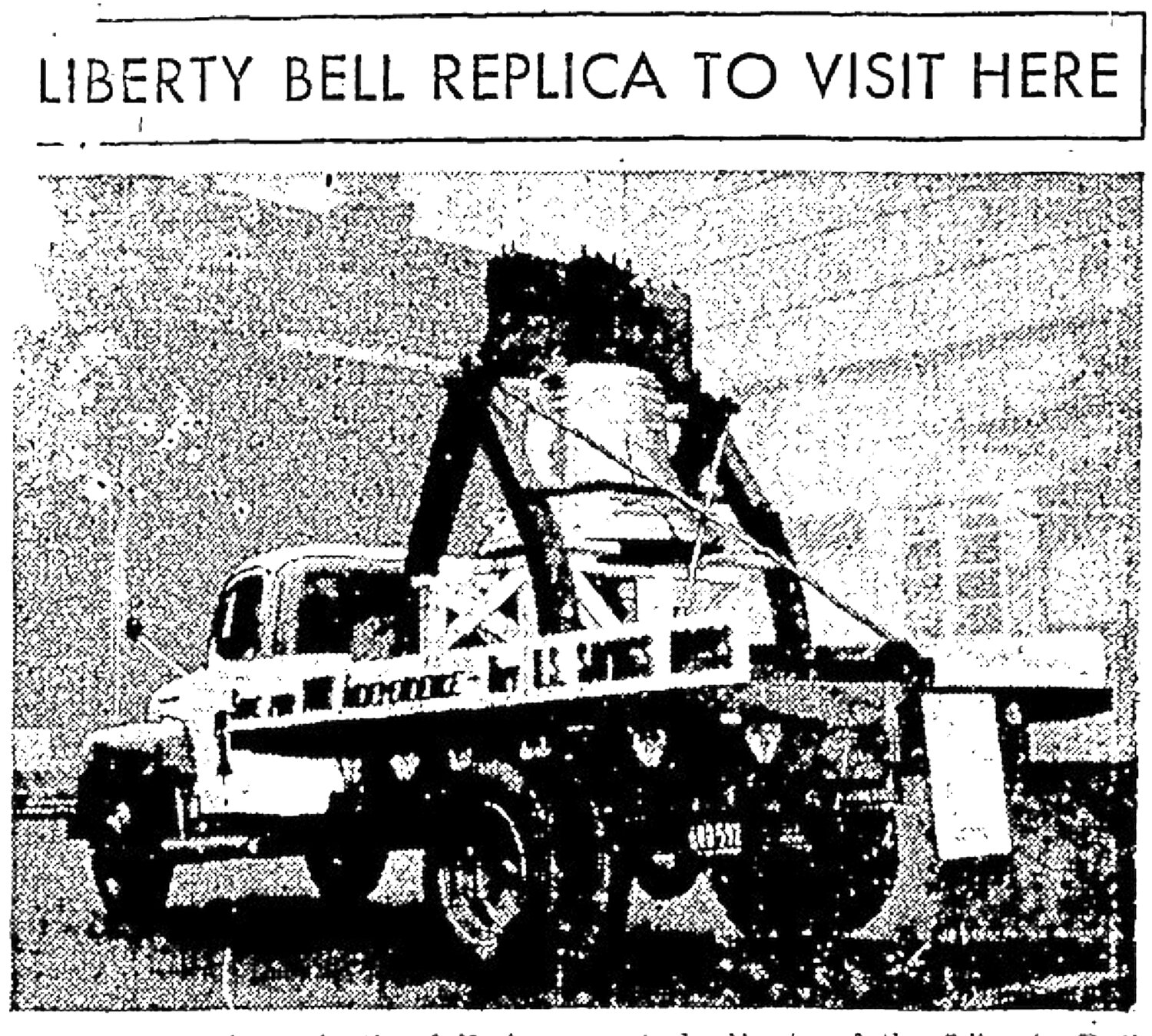
The backstory is that, in 1950, the U.S. Treasury commissioned 52 Liberty Bell replicas — each weighing more than 2,080 pounds and sharing the same dimensions and tone as the famous cracked one in Philadelphia.
The bells, cast at the Paccard Foundry in Lac d’Annecy, France, were sent on state tours to promote Independence Savings Bonds.
The Delaware replica bell made its first appearance in Dover in June 1950 during the Delmarva Chicken Festival. Judging from newspaper coverage, it may have drawn less interest than the event’s 10-foot frying pan.
On July 4, 1950, then-Gov. Elbert Carvel accepted the bell as a gift from treasury secretary John W. Snyder at Delaware Park in Stanton. It had already been decided that it would be sent to Dover for permanent display.
Without fanfare two days later, the Delaware bell was dropped off in a lot next to Dover’s City Hall.
It sat right there, under a tarp, for about 16 months.
***
At first, Dover’s mayor at the time, William J. Storry, announced it would go on The Green.
City Council pooh-poohed that idea, with one member calling it “impractical.”
The bell was a bit of a beast — 3 feet tall. When it was on the flatbed, the truck had to be strapped to the ground because the swinging bell would lift the wheels right into the air.
Loockerman Plaza was pitched as the next alternative. That was shot down due to concern about traffic hazards that it might create.
Next, there was excitement that it could go on the triangle at State Street and Governors Avenue, on the north side of Dover. There, the Friends of Old Dover had maintained a garden on the plot, which was owned by the Richardson family. That idea broke down when covenant concerns arose.
This was in June 1951.
In early November, the city decided on a plot at Division Street and Pennsylvania Avenue.
Reading between the lines of the Delaware State News coverage, it seemed like the mayor was getting exasperated.
During a council meeting, the mayor told the city manager to move it as soon as the city’s crane was repaired.
On Nov. 29, 1951, the bell was hoisted up and trucked over to Division and Pennsylvania, where a concrete foundation was to be built.
That lasted about seven months, before the city finally had an offer of help from the state. A new median on Dupont Parkway, north of the city, seemed ideal.
The State News, in reporting that on July 3, 1952, read, “During the tenure of the bell in Dover, city officials had many incidents in connection with it, but the most amusing one is believed to have been that some small children in the vicinity of Division Street and Pennsylvania Avenue sent a letter to council requesting the removal of the bell from that area, pointing out the ‘Liberty Bell was interfering with their liberty in using the plot for play purposes.’”
The Liberty Bell stayed out of the news, resting quietly on its concrete pad on the highway, until August 1954.
An airman, apparently drowsily driving south, veered off the highway and “struck the liberty bell with sufficient force to knock it about 30 feet from the base.”
When Mr. Raser-Schramm was told this story, he said, “It makes you feel bad for the bell, right?”
***
For more than two decades, the bell remained out on the highway.
In 1976, just in time for the bicentennial celebration, Sen. Jacob Zimmerman, a Dover Democrat, obtained $20,000 in state funds for its move to “Bicentennial Memorial Park” on Federal Street.
“It is hoped we have found a permanent site for the Liberty Bell,” Sen. Zimmerman said. “As it is now placed, it is on a direct line from between the Legislative Hall and the Old State House where the General Assembly met for so many years.”
A big ceremony, with the Caesar Rodney High School band and speeches, was planned for the Fourth of July. In advance, there was a small story on an inside page of the State News.
Even then, it didn’t get the respect it maybe deserved.
That was its first year as a quiet observer of Independence Day fireworks. A block over, there was a much bigger party happening with the Dover Light Infantry reenactment of the events of 1776, complete with the shouting of huzzahs as a portrait of the king was tossed into a roaring fire.
A few days later, the State News published a photo showing the bell situated between flagpoles, with the Old State House in the background.
It has been there ever since as a capital icon, witness to history, serendipitous stop for visitors and a backdrop for many modern selfies.
So, on a twist of the old saying, “all’s bell that ends well.”


