

GEORGETOWN – Springboard Collaborative Pallet Village, a transitional home for those experiencing unsheltered homelessness, is not a magnet attracting additional homelessness to Georgetown, the …

Join our family of readers for as little as $14.99 per month and support local, unbiased journalism.
Already a member? Log in to continue. Otherwise, follow the link below to join.
Please log in to continue |

 By Glenn Rolfe
GEORGETOWN — Springboard Collaborative Pallet Village, a transitional home for those experiencing homelessness, is not a magnet attracting additional people to Georgetown, the collaborative’s co-founder stressed Friday.
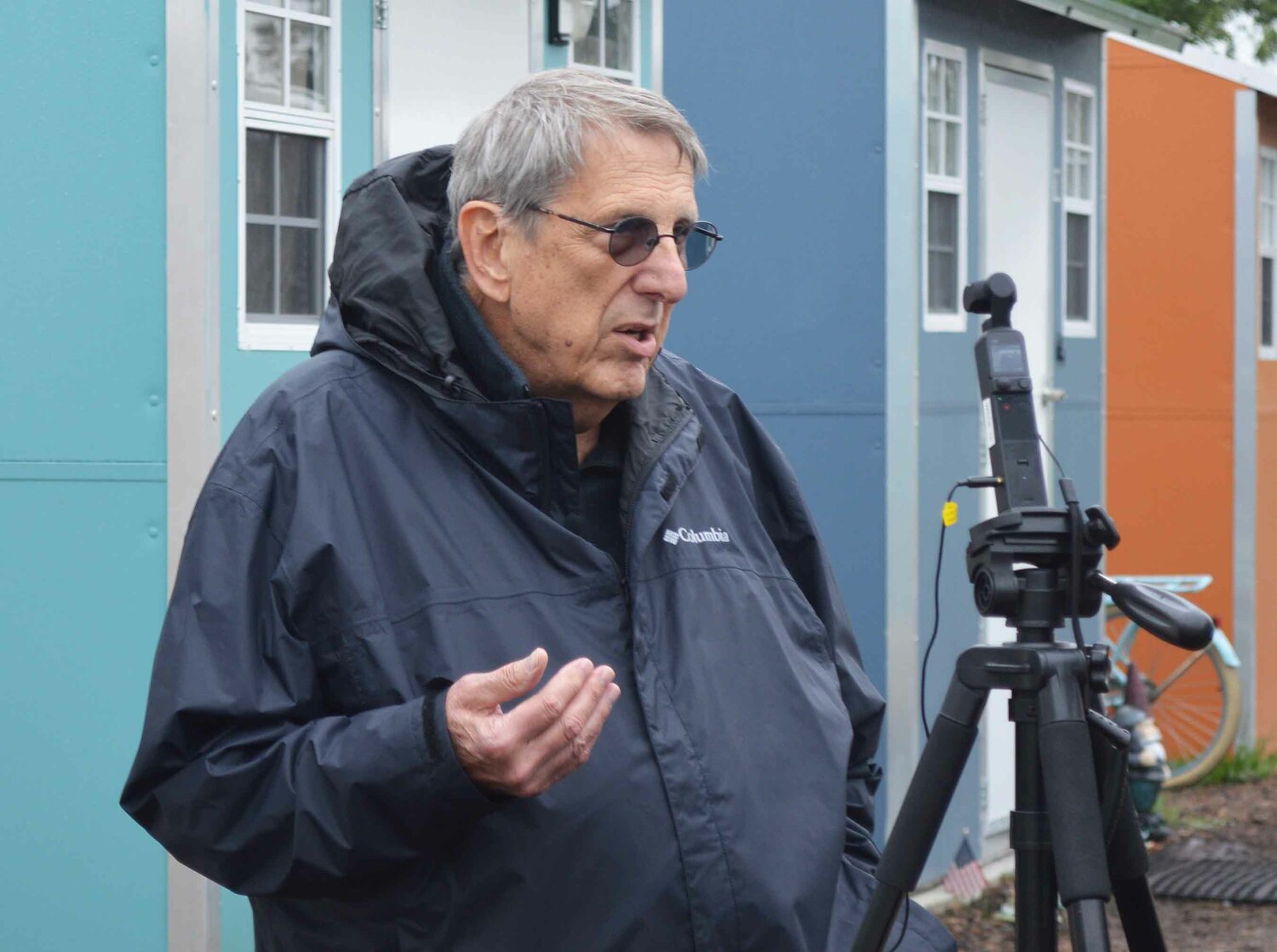
At a press event, Springboard Collaborative executive director Judson Malone dispelled a recent concern.
“The whole program was designed because we had a rising problem with ‘Tent City.’ It was getting out of hand – 70 to 80 people living out there, perhaps more. And, in a very unsafe, violent environment to live in,” said Mr. Malone. “We envisioned this as a place where they get a transition.”
He said there are probably no more than approximately 12 people still in the tent village, deep in the woods off Douglas Street. He noted that another large homeless encampment behind Walmart off College Park Drive is no longer there.
“There is still homelessness in Georgetown. We haven’t eliminated all homelessness in Georgetown,” said Mr. Malone, noting the meaning of poverty and homelessness. “
All homeless are, by definition, in deep poverty. But a lot of people in poverty are not homeless. But they are going where they can get a free meal, or clothing, going where they can get any kind of service.”
Mr. Malone, speaking from the village featuring 40 self-contained cabins off Kimmey Street, said these services don’t necessarily mean there is an influx of new people coming in.
“What it means is they are more visible than they used to be. And that upsets some people because they prefer that they are invisible, because that way they don’t have to think about it,” said Mr. Malone.
Since the village opened in January of 2023, the program has served nearly 120 people. With its 28 partners that include First State Community Action Agency, Brandywine Counseling, Beebe Healthcare, Bayhealth and La Red, it offers various services.
“It has been a remarkable journey for a lot of them. Not all have been a success, but a good majority have been, and they’ve gone on to other places, permanent housing, sometimes a higher level of care,” said Mr. Malone. “And while they’ve been here, the access to reconnection with primary care with mental health services and drug addiction if they have substance-use problems, they have managed to find jobs.
“Most importantly we have had zero deaths from overdose. In fact, we’ve only had three overdose events and those were very early in the program,” said Mr. Malone. “So, if you compare that to what’s been happening in the large community, there is no comparison.”
As of early May, he said 58% of 117 individuals who resided or are residing in the village had income (34 with disability or retirement, and 28 with employment).
Nearly all, 97%, have availed themselves of one or more wraparound services offered by the program’s partner organizations.
To date, 46 individuals received substance-use treatment while residing in the village.
“You don’t have to be clean or sober, but you do have to realize that you are here to work on a housing plan. Whatever obstacles that you are facing to get permanent employment, to get permanent housing, you need to work with our navigators to come up with your own plan,” said Mr. Malone.
“We practice and we preach ‘harm reduction,’ which basically says you need to take care of yourself, and you need to be able to function. The results have been quite good compared to programs that mandate that you be clean before you come in. I think our record of them becoming clean is very impressive compared to traditional programs.”
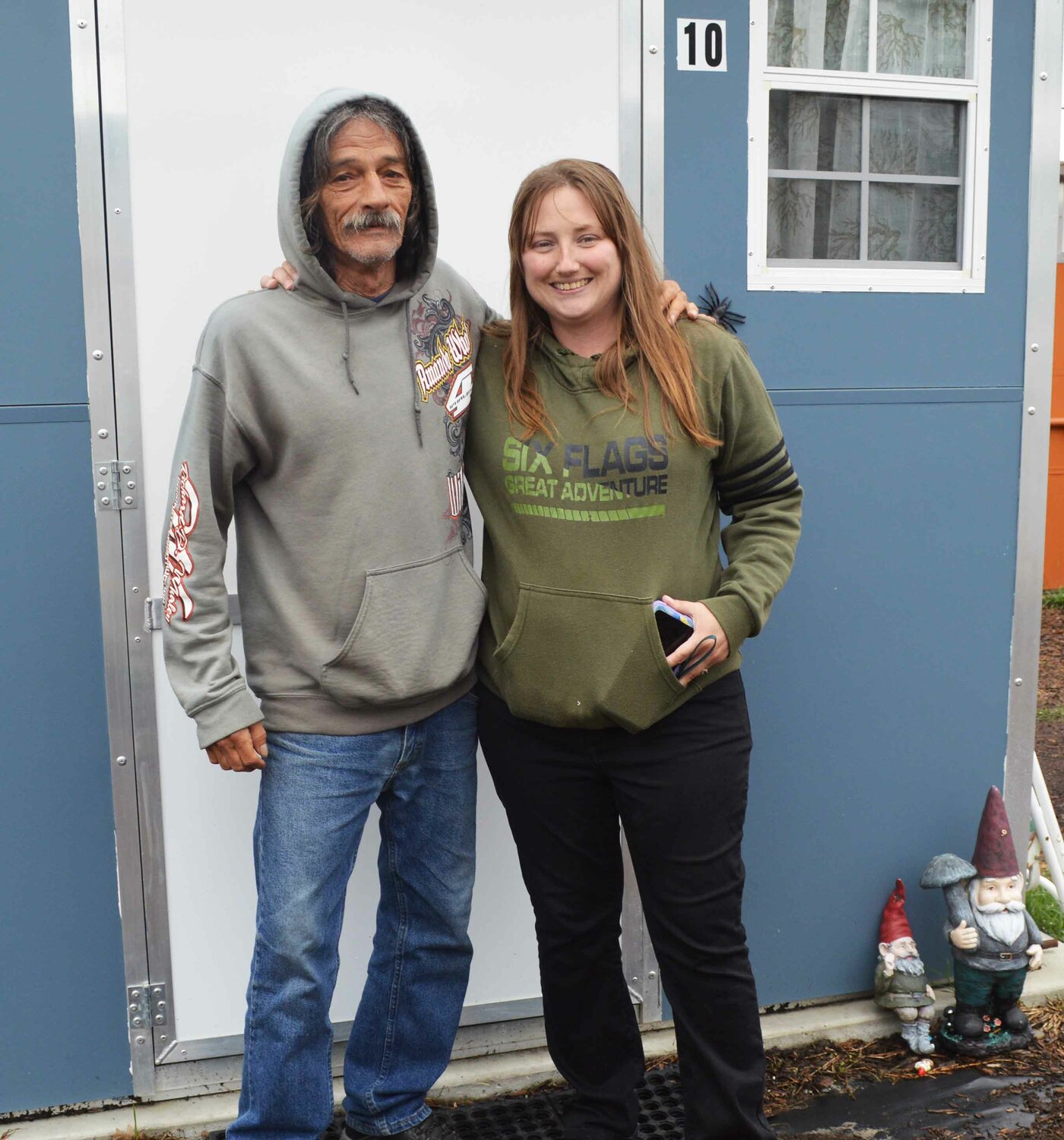
Village resident Anthony Dunlap, 51, is unemployed but on the job hunt. He found himself in a deep emotional and financial rut after his father passed away in February.
“I lost my father and all kinds of stuff, and they just helped me out bigtime. They took me out of a big rut,” said Mr. Dunlap, who refers to his cabin home as his “man cave.” “I have slept outside before in addiction. I got a little messed up and got homeless. Like I said, they’ll help you as long as you want help. If you don’t want no help, move on.”
Richard Jones, a retired 65-year-old village participant for just over a year, is hoping to find a place to call home. He gets a monthly retirement check which he says, “isn’t very much.”
“Looking for an apartment is nearly impossible,” Ms. Jones said. “I came here because there was no other resort. These people helped me out. I don’t do drugs. I don’t drink. I’m normal. And I want to live normal and have my own place.”
Mr. Jones said he has completed about a dozen applications for apartments.
“Richard is unfortunately not an uncommon story,” said Rebecca Ash, a Springboard Collaborator navigator. “We have a lot of the older generation here that are on (Social Security Income). They have a fixed income. The average seems to be between about $800 and $1,200 a month. They qualify for subsidies, but the problem is, the average wait is between like two and four years at this point, He qualifies for a subsidy, which is 30% of his income. So he will have fixed rent, which was created for this situation. But unfortunately, there are more people than there are apartments right now. We apply. We call. We check.”
“Let’s face the fact that we do have people in poverty and in homelessness,” Mr. Malone said. “The humane thing to do is try to come up with positive ways to address it. The Pallet Village is one of those ways. We ultimately still need more permanent housing. We don’t have it. It’s not being built fast enough. So, if it’s not being built fast enough, do we simply let these people die in the woods, or do we provide them with something like the Pallet Village?”
The village is on the property of First State Community Action Agency. The town of Georgetown provided $500,000 in ARPA funding for the 40 sleeping cabins.
On site are several new temporary expansion offices as a permanent community center is to be built. Gatherings are held under a large tent. Construction on the community center is expected to start in a month or so, Mr. Malone said.
Georgetown’s Springboard Pallet Village, a two-year pilot, is privately funded through foundations and philanthropic giving,
“It’s going to be here as long as the need is here,” Mr. Malone said. “The ultimate goal is for this to become a form of homeless service delivery formally recognized in legislation. The model which is being referred to us is a ‘low-barrier navigation center.’ We want this to be defined in legislation. Then we want it to be funded with multi-year contracts to operate it, not only here but any other place in Delaware where there is a need.”


