

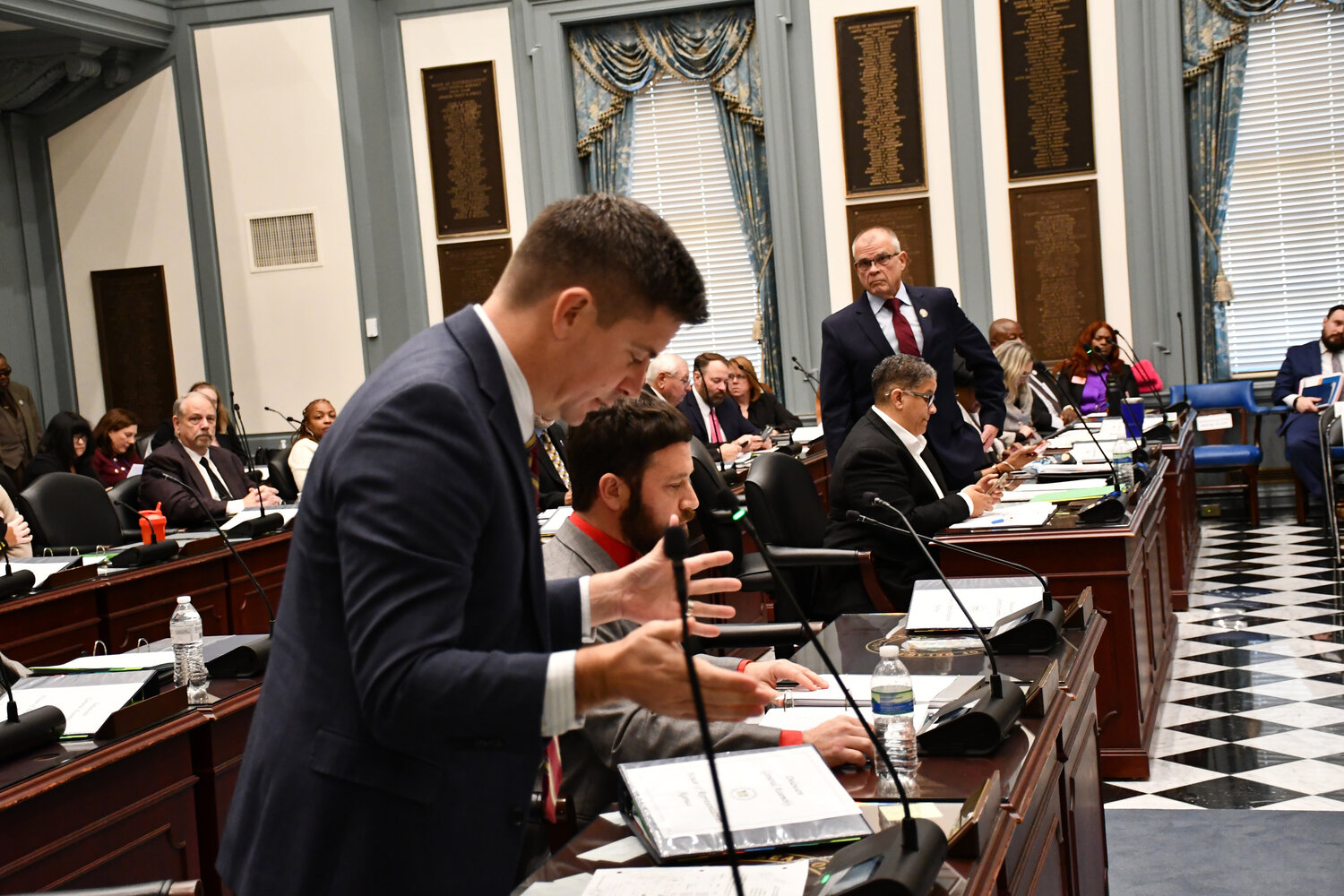
DOVER — The Delaware House of Representatives voted during a Nov. 13 special session to allow its members to attend such gatherings remotely if a quorum is present at Legislative Hall.
These special meetings — defined as business conducted anytime the General Assembly is not in session from January to June — have been much more frequent this year than in the past.
Therefore, House Substitute 1 for House Resolution 19 was introduced by Majority Whip Ed Osienski, D-Newark, to anticipate lawmakers not attending in person in the future.
“This is a measured step toward allowing the House of Representatives to meet timely needs during our traditional offseason,” he said. “We are still a part-time legislature, and everyone here has dealt with balancing a day job, family business or day-to-day life with the work of being a state legislator.
“Sometimes, that balance can be difficult to deal with, especially when unexpected special sessions arrive, causing us to meet quickly.”
The measure was introduced last week, leaving some feeling that it was rushed. Also, at the start of the Nov. 13 special session, technical difficulties cut off sound and video for those watching the live feed virtually.
“Ironically, we just had a break due to technical issues that we were having with the live feed, and then, here we are voting on a rule change specifically around some of those same technical issues,” noted House Minority Whip Jeff Spiegelman, R-Clayton.
Rep. Rae Moore of Middletown was one of two Democrats — with Rep. Madinah Wilson-Anton of Bear — to vote against the proposal. Rep. Moore said it would be unfair to former House members, who had been told they must be present in person to participate.
“When I gave birth, I was told that there were no provisions allowed for remote voting. I was told to show up, and I did just that,” she recalled. “I was not offered, ‘Let’s change the rules.’ I was not even given flexibility.”
Rep. Wilson-Anton agreed, adding that she has also made sacrifices to ensure her presence during last-minute special sessions. Further, she was concerned about the provision that the speaker of the House would give approval about whether a member can tune in virtually or not.
“I do feel that it is cherry picking,” she continued. “And it does leave space for political decisions to be made because who is to say that there are not members on the other side of the aisle who are all the ones, for some reason, who can’t be here in person? And now, for some reason, none of them are given the authority to Zoom in? That, to me, is problematic.”
Rep. Osienski pointed out that both Republicans and Democrats have been utilizing virtual participation in the state Senate for many years, without problems.
The resolution’s final vote was 22-15, with three representatives absent and one abstaining. Because it regards House rules, it does not advance to the Senate.
Subsequent to the legislation’s passage, Rep. Eric Morrison, D-Glasgow, was able to vote remotely for House Bill 255, giving the tax-decoupling bill the three-fifths majority it needed to pass the chamber.


 By
By