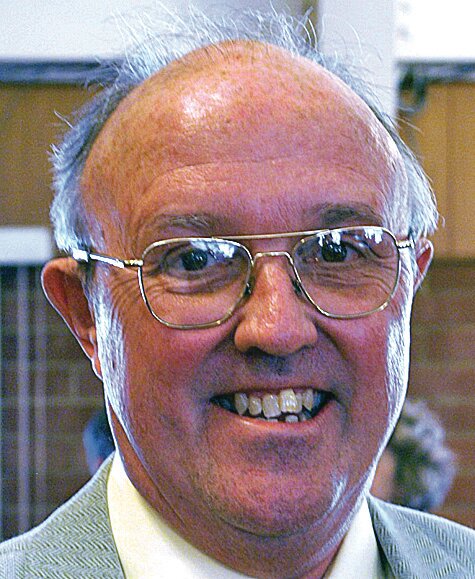
Reid K. Beveridge of Georgetown is a retired Army National Guard brigadier general. He was the editor of National Guard magazine in Washington, D.C., from 1981-96.
Academics and, sometimes, pundits have a word for it. Actually, two words: “rational actor.” In the context of the current Iran war, this has to do with the Iranian national leadership. President Donald Trump discusses this in the context of “Who’s in charge?” If he makes a deal with the “Iranian leadership,” who is it?
The best way to understand “rational actor” is to reflect back on the Cuban Missile Crisis of 1962. To refresh our memories, readers will recall that we discovered, that year, that the Soviet Union (remember it?) had placed nuclear-tipped missiles in Fidel Castro’s Cuba, 90 miles south of the Florida Keys.
As such, the Soviets were threatening nuclear destruction against a good chunk of the southeastern United States, perhaps more. What to do?
Negotiations ensued but not before a lot of threats and saber-rattling. Some advocated invading Cuba. The other side threatened to drop hydrogen bombs on the United States if it did invade. There are at least a couple of theories about what happened next, but one thing became clear. Neither President John F. Kennedy nor Soviet Premier Nikita Khrushchev wanted a general nuclear exchange that would destroy one or both nations. They were rational actors. Didn’t like Khrushchev much? Me neither, but he was a rational actor.
And, as the years rolled off the calendar, both sides have been led by rational actors: Presidents Lyndon Johnson, Richard Nixon, Gerald Ford, Jimmy Carter, Ronald Reagan, George H.W. Bush, Bill Clinton, George W. Bush, Barack Obama, Trump, Joe Biden and now President Trump again.
And, in Russia since Khrushchev was ousted, it’s been Leonid Brezhnev, Yuri Andropov, Boris Yeltsin, Mikhail Gorbachev and now Vladimir Putin. These lists also teach us something else about rational actors.
That is that it has nothing to do with whether you or I agree with any of them. It has everything to do with whether they make decisions that are beneficial to the nations they lead and do little or nothing to endanger their neighbors or others.
We don’t hear much about the Nuclear Non-Proliferation Treaty these days, but the fact is that a number of nations possess nuclear weapons today. They include Great Britain, France, China, India, Pakistan and North Korea. And, most likely, Israel, though that nation won’t admit it.
India and Pakistan are mortal enemies and have fought a couple conventional wars within easy memory. But they haven’t used nuclear weapons. Both are led by rational actors.
When President Obama was leaving office, he advised incoming Donald Trump that his biggest foreign policy challenge would be a nuclear-armed North Korea. Though the threats rain down like an ever-flowing stream, North Korea doesn’t attack anyone. Apparently, it’s led by rational actors — the Kim family: grandfather, father and now son.
The core of the current unpleasantness with Iran has to do almost entirely with its nuclear program and to some extent with its missile program, presumably designed to carry some future nuclear weapon to its target.
To hear it, those targets have the goal of wiping Israel off the face of the world and to also attack us. “Death to America” is the way it is put. Iran has been screeching “death to America” for 47 years, ever since the Ayatollah Ruhollah Khomeini overthrew the shah in 1979.
A series of presidents — Trump is only the most recent — have said Iran cannot be allowed to have a nuclear weapon because we believe that, unlike the other nuclear-armed nations, Iran would use it.
We know it already has missiles that would reach Jerusalem and Tel Aviv. It likely has missiles that would reach some or all of Europe. It has been working hard to develop a missile that would reach the eastern United States.
Thus, the big problem is the leadership: Are they rational actors? Hence the problem is, who are those leaders?
Before Epic Fury, we knew it was the supreme leader. But he was killed in the first barrage. Supposedly, Ayatollah Ali Khamenei’s son is the new supreme leader, but the world has not seen him nor heard from him directly. It may be the commander of the Iranian Revolutionary Guard, but we don’t know that for sure.
Are these men rational actors? We don’t know.
Reader reactions, pro or con, are welcomed at civiltalk@iniusa.org.