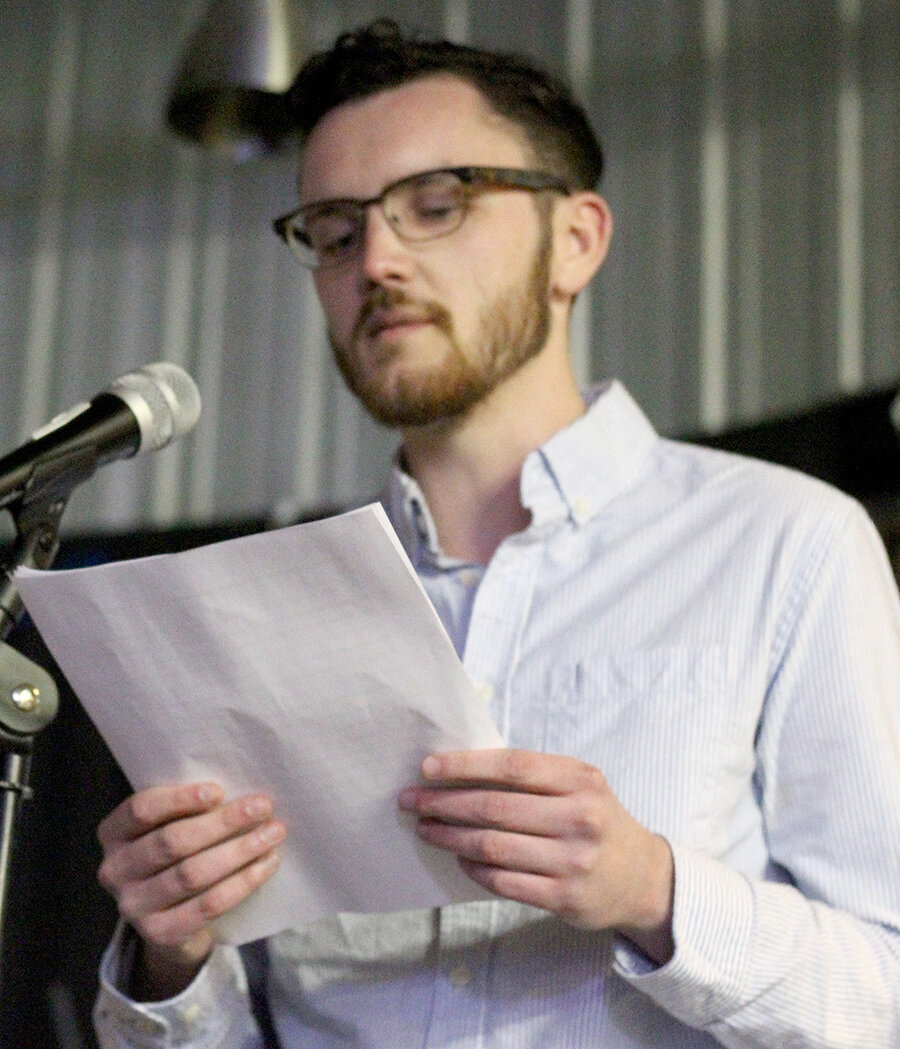
Jordan McClements is a writer, composition/literature instructor and recovering heroin survivor, as well as a Master of Fine Arts student at Columbia College Chicago. He resides in Felton.
Native American Heritage Month is celebrated in November.
How do you discover a people?
You don’t, and you and Christopher Columbus never did.
Discover yourself.
So, you do:
Chicago, Museum of Contemporary Art, Aug. 29, 2023. The summer ends tonight and screams your name. The last concert series of jazz at the Museum of Contemporary Art. You buy two glasses of white wine to feel the electricity radiate its currents across your veins and the loss you count between. You meet an actress named Lena, who you converse on playwrights and jazz musicians with. She is in a rhapsody’s tinge of white, sand-colored dress, which evokes a warmth only the call of Rajiv Halim’s jazz band, in time with police and ambulance sirens that pass by the performance, contains. The sun drips off the skyscrapers in River North like teardrops echoing out the dreams of your darkest nights. A drain in the warmth of the trees, placating decadence like laughing at time, as if youth could be captured in a movement. Today is Charlie Parker’s birthday. Blow, Bird, blow. They did. Runere Brooks’ upright bass, swinging like a boxer, counting jabs as poetic. Samuel Jewell’s drums crashing through a sandstorm, like tempests across a desert. Rajiv Halim on sax and Norman Palm on trombone reach infinity and catch your beyond. While on keyboard, Julius Tucker plays your sweetheart’s memories. You see Lena in the sand-colored long dress, Lena’s beautiful brunette bangs, but most of all? The hazel eyes you meet across the aisle, as if you married Lena. But that’s the thing, the summer ends but not its revelations.
You look White, but Mom is an Alaska Native. You bared witness and laid testament to “mymothersside” by Duane Linklater at the Museum of Contemporary Art. It gave you the courage to write about being a mixed person passing for White. The texts “Custer Had It Coming” and “Boys Don’t Cry” leered through the fragments of your eyes, as you see hide and skin on the wall. To the right, in a triptych, displaying the real biblical scene, nailed like the shape of a Batman symbol, as Native people and their narratives are consumed, Native people bearing the crucifix of insignia, resulting from settler colonialism.
From first grade to now, you never thought to call yourself Indigenous, biracial or mixed because everyone in school told you that you were too White to also be an Alaska Native.
You asked Mom, to stop passing, today:
“What are we?”
“I’m not anything. Alaska Athabaskans. That’s your heritage. That’s my heritage. I get sensitive about my heritage. Don’t talk about your heritage like that. Your great-grandmother, who had a third grade education and died of an alcoholic seizure, she was Native Alaskan. She had pitch-black, real dark eyes, real beautiful. Supposedly, I resembled her. Yeah, and she had eight children.”
Maybe Mom talked like that to survive. To pass. Mom had made it through multiple foster homes in Alaska before Muh Mum and Puh Pup adopted her. You never went through what Mom did.
Your former teacher from your first graduate degree in English at the University of Louisiana at Lafayette remarked today at Khapri, the coffee shop by the Kedzie Brown Line, that you were lucky. Though you come from working class people, you were lucky enough to be in the process of starting your third graduate degree, at Northwestern. An MSJ in social justice and solutions journalism, covering the overdose crisis.
As you celebrate Charlie Parker’s birthday today, you realize Parker and you both struggled with heroin. Though you haven’t used heroin in six years, the biggest mainline you’ve ever felt was staring at “mymothersside” at the Museum of Contemporary Art today. The pieces allowed for you to feel your identity in your culture for the first time, despite being told by students and educators around the United States that, because your skin is whiter than what they believed Native people look like, you aren’t Native.
The pieces gave you the ability to feel Mom’s pain and Mom’s courageous fight in being alive. Surviving a car accident, where a Mack truck hit Mom on Mom’s side of the car because Mom’s boyfriend was drinking before picking Mom up that night, on Mother’s Day. You were 3 years old when Mom entered the coma that night. You didn’t see Mom for six months of your life during that formative year. Mom said death was rowing Mom to hell in a dark cloak, and Mom was cold and shivering, saying till Mom woke up:
“I have to save my son. I have to save my son.”
You still catch yourself telling Mom you miss her, even though you’re in the same room, spending time with Mom. The exhibit gave you a voice, expensing “Boys Don’t Cry” and “Cry Don’t Boys,” but even though you are bleeding tears for Mom, you are painting rhythms through the flood, for the part of you that hurt yourself in passing, and believing your own double consciousness of not knowing yourself. Whether boys don’t cry or not, you are screaming the tears of knowing yourself, tonight, for your mother’s side.
Reader reactions, pro or con, are welcomed at civiltalk@iniusa.org.