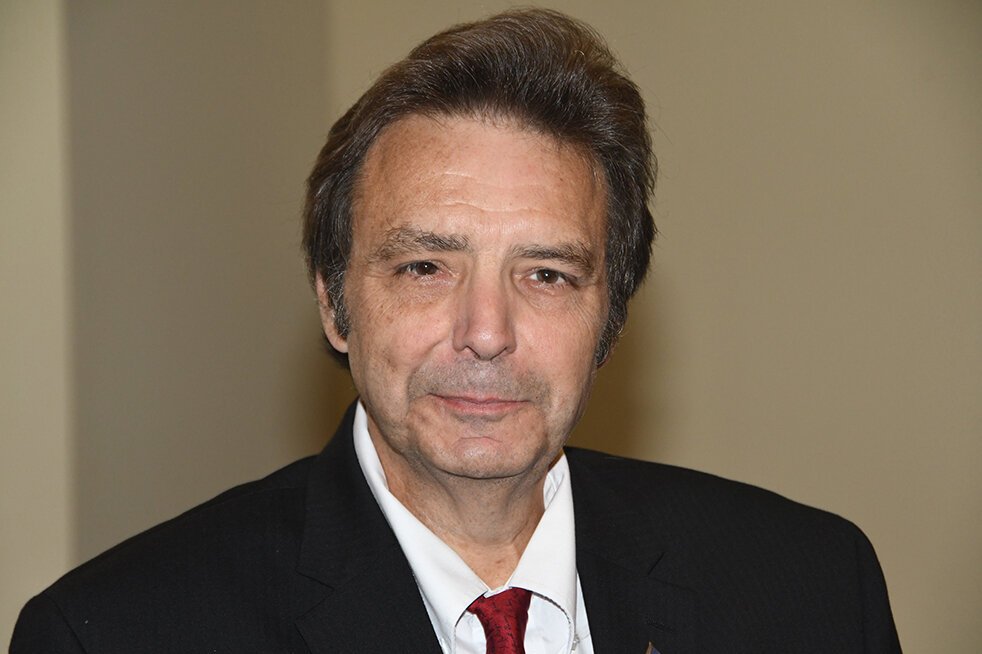
Dr. Samuel B. Hoff is a George Washington Distinguished Professor Emeritus of history and political science at Delaware State University. He served as an assistant to the late U.S. Sen. Jacob Javits — the primary author of the War Powers Resolution — from 1983-85 at the State University of New York at Stony Brook.
According to White House files from the Richard Nixon administration, aide David Parker wrote a memo to chief of staff Alexander Haig on Nov. 7, 1973. The missive proposed that the president invite supporters over for drinks if his veto of the War Powers Resolution was sustained later that day. It wasn’t: The veto override that ensued left the legislation intact. A half-century later, we can unabashedly commemorate this controversial yet critical law.
Though the Framers directly experienced executive abuses of war powers by Colonial governors and British monarchs, they faced the quandary of how to divide war powers once the presidential office was established in the Constitution. The final arrangement — that Congress would possess authority to declare war and that the president would serve as commander in chief — didn’t seem to be problematic at first. But differing interpretations of constitutional language; the increasing regional, and later global, role of the United States; national emergencies; augmented tools of presidential action; and decades of congressional deference created an imbalance in war powers favoring the president.
The nation’s entry into the Korean War in 1950, which was justified as an international police action, was not accompanied by a declaration of war. Though congressional opposition to the war was minor, it led to a comprehensive study of war powers between the president and Congress. Fourteen years later, Congress greenlighted a reprisal to a minor attack by North Vietnam against American Naval forces and, in doing so, granted the Lyndon Johnson administration latitude to significantly widen U.S. participation in the Vietnam War. Though the Johnson White House authorized troop increases reaching a half-million, lack of success in defeating North Vietnam led President Johnson to decline to run for reelection in 1968.
Richard Nixon won the 1968 presidential election partly based on his promise to end American inclusion in the Vietnam War. But his war policy came under attack by Congress in 1970, after the U.S. entered Cambodia to stop Viet Cong from using the Ho Chi Minh Trail there. It was at that time that Congress renewed a push for a clarification and clear delineation of war powers. That round of war powers proposals was unsuccessful, as was another in late 1972, shortly before the Nixon administration ordered bombing and mining of harbors in North Vietnam to hasten agreement of a peace deal. However, both chambers of Congress passed war powers bills in 1973, necessitating a conference committee to iron out details.
The compromise legislation that emerged, the War Powers Resolution of 1973, required the president to inform Congress where possible before American troops would be dispatched to a hostile situation; to report on the operation within two days of its start; and to remove troops within two months unless Congress approved an extension.
President Nixon vetoed the bill on the last day possible, claiming that it was unconstitutional and undermined the nation’s foreign policy. The override of the veto was the last one suffered by the Nixon White House before the president resigned a year later.
It is easy to view the War Powers Resolution as part of a congressional gang-up on the presidency and Richard Nixon in particular. For Nixon, 1973 was a nightmare already, as he was mired in the Watergate scandal, saw the resignation of his vice president amid corruption charges and had to deal with high gas prices imposed by OPEC, partly due to the Yom Kippur War in the Mideast. Upset by perceived executive usurpations in a number of areas, Congress enacted the Case-Zablocki Act in 1972; the Budget and Impoundment Control Act, along with the Hughes-Ryan Amendment, in 1974; and the Arms Export Control Act of 1976.
Likewise, one could point to major American wars in Afghanistan and Iraq, combined with dozens of more limited military missions, as evidence that the War Powers Resolution has been feckless because it has never been officially fully invoked, and no war has been declared since World War II. Additionally, conservatives in Congress have consistently sought to derail the law: Bills to repeal the resolution were initiated in the House of Representatives and Senate in 1983 and 1987, respectively; the Senate attempted to revise WPR in 1988; both the House and Senate tried to repeal the law in 1995; and a bipartisan commission recommended its repeal in 2008. Finally, in two federal cases dealing with WPR, U.S. District Court (1981) and U.S. Court of Appeals (2000) judges rejected challenges to American military operations.
Yet, with all that being admitted, there is still a strong case that the War Powers Resolution has achieved its aims, even if indirectly. A 2017 study by the Congressional Research Service revealed that U.S. presidents from Gerald Ford to Donald Trump submitted 130 reports to Congress in which military actions were reported “consistent” with the requirements of WPR. Further, the resolution has obviously contributed to Congress’ recent proclivity to sunset war moves, including the effort by both the House and Senate to repeal the 2002 authorization for force in Iraq. Finally, the War Powers Resolution has stood alongside court rulings that have limited the president’s war authority, including the U.S. Supreme Court’s ruling in Boumediene v. Bush (2008) on the rights of detainees, among others.
Rather than a transient, stopgap piece of legislation, the War Powers Resolution re-energized the timeless debate over which branch controls the war power — Congress or the American president. In a constitutional republic, it must be both.
Reader reactions, pro or con, are welcomed at civiltalk@iniusa.org.